













Şirket
28 September 2026
 10:28
10:28 Allen Wang | CEO and Founder, HIPAD
Updated: August 15, 2026
Selecting a window hardware manufacturer is an engineering and supply decision. A distributor may need a coordinated range of locks, handles, hinges, rollers, seals, fixings, and replacement parts, while a window fabricator must also protect profile compatibility, installation efficiency, finish consistency, and repeat-order interchangeability.
This guide gives B2B buyers a practical way to compare manufacturers before requesting samples or placing an OEM order. It focuses on the evidence that can be checked: product-family coverage, drawings, interfaces, materials, finishes, customization controls, inspection, documentation, packaging, and change management.
A useful inquiry begins with the complete window specification. State whether the system is sliding, casement, awning, top-hung, tilt-and-turn, louvre, or another configuration. Supply the frame and sash profile, material, opening direction, frame thickness, mounting space, hole pattern, spindle or lock interface, required function, finish, quantity, and target market.
| Buyer input | What the manufacturer should confirm | Risk controlled |
|---|---|---|
| Profile drawing or sample | Mounting footprint, clearances, fixing depth, keep and lock position | Parts that cannot be installed or engage correctly |
| Opening type and handing | Compatible handle, hinge, lock, roller, and accessory arrangement | Wrong function or reversed components |
| Frame or sash thickness | Spindle, screw, lock case, cylinder, and fastener lengths | Insufficient engagement or interference |
| Environment | Base material, finish process, fasteners, seals, and maintenance needs | Corrosion, finish damage, or premature wear |
| Approved appearance | Color, gloss, texture, visible surfaces, and sample reference | Batch-to-batch inconsistency |
| Order structure | MOQ, tooling, samples, packaging, lead time, and repeat-order controls | Commercial surprises after approval |
Photos help identify the general family, but they do not define a fit. Mark critical dimensions on a controlled drawing and assign a revision number. When replacing existing hardware, send an original sample together with the profile section and explain which dimensions must remain interchangeable.
A broad catalog matters only when it matches the buyer’s window systems. HIPAD’s published range covers sliding window rollers and accessories, casement and sliding window handles, keyed window locks, replacement hardware, and standard through heavy-duty window hinges. Buyers can review the window lock range, window hingesve handle options as a starting point.
For each product family, ask the manufacturer to identify standard models, configurable models, and parts that require new tooling. This distinction affects sample timing, minimum quantities, investment, and future replacement availability. A coordinated supplier can reduce vendor count, but buyers should still approve every interface and product family separately.
Window Locks with Key are a relevant sourcing category for distributors and fabricators that need controlled access or keyed operation. The correct lock depends on the opening type, profile, door or sash thickness, backset, mounting preparation, keep position, cylinder or key system, handing, and required function.
| Published lock family | Published application range | Buyer checks before approval |
|---|---|---|
| Mortise locks | 35-70 mm aluminum doors | Backset, faceplate, case depth, spindle, cylinder, strike, handing |
| Sliding-door locks | 30-60 mm doors | Hook or latch engagement, keep geometry, handle interface, travel |
| Crescent locks | Sürgülü pencereler | Meeting-rail offset, mounting centers, keeper height, direction |
| Multipoint locks | 40-80 mm entrance doors | Gearbox, rod or faceplate length, locking points, handle and cylinder |
| Cylinder locks | Brass and steel construction | Cylinder format, length, cam, keying request, mating lock case |
These published ranges are selection references, not proof that every model fits every profile. Request the model drawing and verify the assembly on the actual extrusion or a representative test section. Pricing is quotation-based because geometry, material, finish, keying, packaging, quantity, and customization change the commercial result.
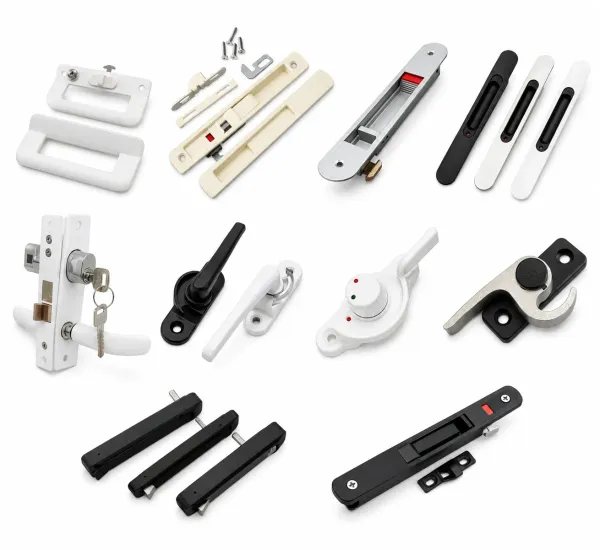
Handle selection includes more than shape and color. Confirm the base footprint, mounting centers, spindle size and projection, screw length, lock or gearbox interface, handing, rotation, clearance from the frame, and whether the handle blocks blinds, screens, or adjacent panels.
HIPAD’s published references include aluminum or zinc window handles for 40-70 mm frames and aluminum flush handles for 30-60 mm sliding-window frames. Treat those ranges as family-level guidance and verify the exact model drawing. For private-label programs, define logo location, marking process, visible molding or die-casting surfaces, finish reference, packaging, and replacement-part identification before approval.
Window hinge choice depends on sash size and mass, opening angle, fixing pattern, profile reinforcement, environment, usage, and the complete hardware arrangement. The published window-hinge references include standard stainless-steel hinges at 2-3 mm thickness, industrial hinges at 3-5 mm, furniture/light-application hinges at 1.5-2 mm, and heavy-duty hinges at 4-6 mm. Thickness alone does not establish capacity or suitability.
Ask for the model-specific material, geometry, fixing recommendation, and declared application data. A physical fit and function check on the representative sash is stronger evidence than comparing catalog labels such as “standard” and “heavy duty.” For educational reference, EN 1935 addresses requirements and test methods for single-axis hinges, but the buyer must confirm whether a specific product has applicable test documentation.
Window hardware commonly combines aluminum, zinc alloy, stainless steel, carbon steel, brass, engineering plastics, rubber, and surface treatments. Ask which material is used for each functional component rather than accepting one headline material for the assembly. Confirm exposed and concealed fasteners, springs, pins, cylinders, bearings, and mating parts.
Finish names such as matte black, silver, white, anodized, plated, brushed, or powder coated are incomplete specifications. Approve a physical sample and record the substrate, process, color reference, gloss, texture, visible surfaces, acceptable process marks, and packaging protection. If the application has coastal, wet, chemical-cleaning, or high-UV exposure, disclose it before the manufacturer recommends a material and finish.
OEM window hardware may involve dimension changes, new profiles, private molds, material substitutions, finish matching, logos, labels, and custom packaging. Each change should have an owner, drawing revision, sample status, and approval record.
The lowest tooling quotation is not automatically the lowest program cost. Compare ownership, expected maintenance, permitted revisions, replacement-tool policy, sample rounds, and what happens if the design changes. Commercial details must be confirmed in the quotation and purchase agreement.
A manufacturer comparison should use evidence tied to the order: incoming-material controls, in-process checks, dimensional inspection, finish inspection, assembly checks, functional checks, packaging verification, traceability, and handling of nonconforming parts. Request sample reports that show the fields and measurements relevant to your model.
HIPAD states that it uses in-house quality checks through production and can cooperate with third-party inspection providers such as SGS and Bureau Veritas. The company also states ISO 9001 management. ISO 9001:2015 provides quality-management-system terminology; it is not a product certificate and does not prove that a particular lock, handle, or hinge meets a project requirement.
For lock-related educational reference, EN 12209 covers mechanically operated locks, latches, and locking plates. Do not assume a model is tested or certified to that standard. Ask for the exact report, product identification, edition, laboratory, classification, and scope when compliance is required.
Sample inspection should include identity, drawing revision, dimensions, fit, movement, engagement, fixing, handing, surface appearance, markings, accessories, and packaging. Install the sample on the intended profile. For locks, check the handle, spindle, cylinder, lock case, keep, and closing alignment together. For hinges, check opening, clearance, fixing access, and sash alignment. For rollers, check the track, wheel, adjustment, guide, and stopper as one system.
A pilot order tests more than the product. It also reveals labeling, carton quantities, protective packing, assembly instructions, barcode data, document flow, and communication around deviations. Record the accepted result so the mass order and future repeat orders have a stable reference.
Distributors often need retail-ready or private-label packs, while fabricators may prefer production-line kits. Define item code, model, finish, handing, quantity, barcode, language, logo, instruction sheet, carton sequence, and pallet protection. Keep spares clearly separated from production quantities.
For repeat orders, reference the approved model, drawing revision, material, finish sample, packaging artwork, and original purchase order. Require notification before changes to the material, subcomponent, tooling, finish process, production location, or packaging. A small undocumented change can break replacement fit or create visible differences across one project.
Send the window type, profile drawing or sample, opening direction, critical dimensions, interface details, function, material and finish request, quantities, target market, packaging, required documents, and expected delivery plan.
HIPAD publishes door, window, sliding-system, lock, handle, hinge, roller, seal, and accessory categories. Each selected model still needs separate compatibility and approval checks.
Use the same controlled requirement sheet. Compare model scope, materials, finish, tooling, samples, MOQ, packaging, inspection, documentation, lead time, change control, and commercial terms, not only unit price.
No universal public price range or MOQ is disclosed. A quotation is required because the product, material, finish, tooling, packaging, quantity, and delivery requirements affect the offer.
Retain the approved sample, model code, drawing revision, critical dimensions, material, finish, and original order reference. Require written notice before any product or process change.
A strong manufacturer comparison begins with the same measurable specification for every candidate. Provide the profile, interfaces, function, appearance reference, quantity, OEM scope, packaging, and acceptance criteria. This gives the manufacturer enough information to identify risks before sampling and gives the buyer a defensible basis for approving the order.
HIPAD ile İletişime Geçin with your window profile drawing, existing sample, hardware list, quantities, finish reference, branding request, and packaging requirements for a project-specific review and quotation.
Allen Wang is CEO and Founder of HIPAD. He began his career in 1998 as a technical engineer in Qingdao, developing hands-on experience in manufacturing processes, tooling, mechanical components, and product quality. His work with international distributors, door and window manufacturers, contractors, and project buyers covers product selection, material and finish matching, drawing-based customization, OEM/ODM development, private molds, packaging, and system compatibility.
24 saat içinde yanıt vereceğiz. Acil talepleriniz için WhatsApp/WeChat üzerinden +86 137 9191 8989 numarasından bize ulaşabilir veya aynı numarayı doğrudan arayabilirsiniz.
*Gizliliğinize saygı duyuyor ve tüm bilgilerinizi koruyoruz.
Bilgilerinizi yalnızca talebinize yanıt vermek için kullanırız; izniniz olmadan e-posta veya tanıtım mesajı göndermeyiz.