


Şirket
19 Ekim 2026
 10:03
Allen Wang | CEO ve Kurucu, HIPAD
Updated: October 19, 2026
A pivot door system needs approval as an installed assembly, not by a headline weight alone. HIPAD’s supplied Door Controls reference lists pivot systems up to 200 kg with a 180-degree opening reference. Those figures help shortlist the family; they do not establish the rating, floor anchorage or achievable opening of every model in every entrance.
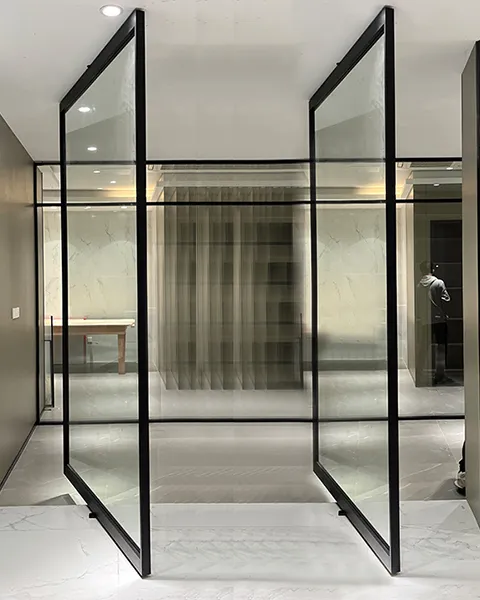
HIPAD’s Door Controls product reference includes the following family descriptions. They are selection references, not a substitute for model-specific test documents or structural approval.
| Control family | Published door-weight reference | Published opening reference | Primary question before selection |
|---|---|---|---|
| Pivot system | 200 kg'a kadar | 180 degrees | Can the chosen pivot, door and floor/head structure work together? |
| Floor spring | 150 kg'a kadar | 180 degrees | Is closing control required, and is the floor condition suitable? |
| Door closer | 60-120 kg | 120-180 degrees | Does the selected closer match the door and closing duty? |
| Stainless-steel patch fitting | No numerical range stated | No angle stated | Is the glass and fitting interface specified for the assembly? |
These are different functions and are not interchangeable solely because their published angles overlap. A pivot defines the rotation support; closing behavior and glass attachment may require other compatible components. Review the Door Controls range as a system, then request the exact drawings and evidence for each selected component.
Door mass is only one input. Give the supplier the door height, width, thickness, material, glazing arrangement and the pivot’s offset from the door edge. A wide leaf changes the operating geometry and loading at its supports even when its mass is unchanged. Ask for the proposed model’s declared door-size limits, fixings and installation conditions instead of treating the family maximum as an approval for a particular entrance.
Also identify whether the system is intended for a single leaf, a paired entrance or a replacement retrofit. In a retrofit, concealed services, finished flooring and existing recesses may constrain the pivot location. Do not choose a pivot solely because another site used a door of similar weight; that comparison omits the floor and head construction.

The 180-degree pivot reference does not promise that every installed leaf reaches a full half-turn. Wall returns, adjacent glazing, handles, stops, floor finishes and the selected pivot offset can reduce the usable angle. Confirm the required clear opening in the door schedule, then test a production-intent assembly through its full travel. Check sweep clearance, edge contact and hardware interference at intermediate positions, not only when fully open.
If the project needs self-closing or controlled closing, define that requirement separately. A door-closer selection guide explains why weight and angle references have to be checked against the real opening geometry. Do not infer that every pivot system includes a closer.
Ask the project engineer to identify the supporting substrate, finished floor build-up, recess depth, waterproofing and available fixing zones. The supplied HIPAD reference does not give one universal anchor design or floor-load calculation. Any fixing schedule must therefore be approved for the actual structure and the quoted model. Keep the upper support and door-leaf preparation in the same drawing set so their axes can be checked together.
For a glass entrance, verify the glass preparation and fitting interface against the chosen patch fitting. HIPAD’s supplied catalog lists stainless-steel patch fittings but does not publish a single numerical capacity for that family. A picture of a fitting cannot establish glass thickness, hole geometry or compatibility; request the model drawing and required glass specification.

HIPAD describes OEM/ODM support for custom drawings, structure and packaging. For a broader supplier review, use the door hardware manufacturer checklist. The source material does not disclose pivot-system prices or product-level certificate numbers; request a quotation and documents for the defined model.
No. It is a published family reference. The chosen model must be checked against door geometry, fixing conditions and the supplier’s model-level limits.
Do not assume so. Specify the required closing behavior and confirm the compatible control components for the offered assembly.
No. The installed angle depends on pivot offset, adjacent construction and hardware. Verify it on a representative entrance.
Include the floor section in the inquiry. The proposed model, recess and fixing scheme need approval for the actual construction before ordering.
To plan an OEM sample or request a model-specific quote, contact HIPAD with the door schedule, floor/head details and opening requirement. If the entrance uses heavy hinges elsewhere, the hinge guide helps keep those separate hardware decisions explicit.
About the author: Allen Wang is CEO and Founder of HIPAD. His supplied background describes manufacturing experience beginning in Qingdao bearing production in 1998 and work with international door and window hardware buyers. This guide uses HIPAD’s Door Controls family reference; a project specification still needs model-level documents and installation review.
24 saat içinde yanıt vereceğiz. Acil talepleriniz için WhatsApp/WeChat üzerinden +86 137 9191 8989 numarasından bize ulaşabilir veya aynı numarayı doğrudan arayabilirsiniz.
*Gizliliğinize saygı duyuyor ve tüm bilgilerinizi koruyoruz.
Bilgilerinizi yalnızca talebinize yanıt vermek için kullanırız; izniniz olmadan e-posta veya tanıtım mesajı göndermeyiz.
