













Şirket
28 September 2026
 11:32
11:32 Allen Wang | CEO and Founder, HIPAD
Updated: August 14, 2026
Bulk door hardware purchasing is a system-matching task, not simply a request for a carton quantity. Project buyers need handles, locks, hinges, rollers, bolts, controls, fixings, finishes, and packaging to work with the same door specification and delivery plan. A low unit price does not protect a project when hole centers, handing, spindle dimensions, door thickness, or finish references are inconsistent.
This guide gives procurement teams a practical route from door schedule to repeat order. It applies to distributors, fabricators, contractors, and brands buying architectural hardware for commercial, residential, hospitality, bathroom, glass-door, and sliding-door programs.
Start with the opening schedule and divide it into hardware sets. Each set should identify the door type, material, thickness, handing, frame or profile, function, environment, traffic level, fire or accessibility requirements supplied by the project consultant, and the hardware items required for one opening. This prevents the purchasing list from becoming a collection of unrelated SKUs.
| Input | What the buyer should provide | Procurement risk controlled |
|---|---|---|
| Door and frame | Door material, thickness, profile section, handing, swing or sliding direction | Wrong fixing depth, interference, or incompatible mounting |
| Fonksiyon | Passage, privacy, keyed entry, emergency exit, hold-open, or controlled closing requirement | Incorrect lock, latch, cylinder, or control selection |
| Interfaces | Hole centers, backset, spindle, lock case, track section, roller cavity, glass thickness | Parts that cannot be installed together |
| Environment | Interior, exterior, wet area, coastal exposure, chemical cleaning, temperature range | Premature corrosion, finish damage, or material mismatch |
| Bitiş | Approved physical sample, color reference, gloss, texture, visible surfaces | Batch-to-batch appearance variation |
| Logistics | Opening number, room or zone, set number, carton label, delivery phase | Sorting errors and site installation delays |
For a broad product-family overview, review HIPAD’s door hardware range. Buyers should still request model-specific drawings because a family-level description does not establish compatibility with a particular opening.
Calculate quantities from the approved door schedule rather than an estimated building total. Multiply each hardware set by its opening count, then add separately approved spare quantities. Do not apply one spare percentage to every component without considering replacement frequency, lead time, finish sensitivity, and whether the part is standard or project-specific.
A common edge case is a late door-schedule revision after hardware production starts. The buyer should isolate changed openings, identify affected components, and issue a written delta order. Replacing the entire purchase sheet without a change log can create duplicate quantities and obsolete finished goods.
Bulk door hardware should be approved as connected components. A handle must suit the lock case and spindle. The lock must suit the backset, door preparation, cylinder, strike, and handing. Hinges or rollers must support the door construction and mounting geometry. Closers, floor springs, pivots, stops, and flush bolts require enough installation space and suitable reinforcement.
For sliding openings, check the track, wheel material, bearing arrangement, bracket, adjustment range, guide, stopper, and door weight together. HIPAD’s door roller range ve sliding door fitting guide show why the roller cannot be selected independently from the track and door.
Request an interface drawing for every nonstandard or critical assembly. Mark the dimensions that stop installation if incorrect: mounting centers, base footprint, spindle engagement, backset, fixing thread, glass cutout, track cavity, bracket offset, and edge clearance. The approved drawing should carry a revision number and date.
Material selection should follow the application, load path, corrosion exposure, machining process, and mating components. Stainless steel, aluminum, zinc alloy, steel, engineering plastics, rubber, and TPE serve different functions across a hardware package. The base material does not by itself define finished performance; grade, section, heat treatment where relevant, fasteners, coating, and contact between dissimilar materials also matter.
Finish descriptions such as matte black, satin, polished, brushed, or anodized are not complete acceptance standards. Use a signed physical sample or controlled color standard, then define the substrate, gloss, texture, visible surfaces, permitted process marks, and packaging protection. Read HIPAD’s door hardware finish guide for additional selection considerations.
The trade-off is practical: tighter appearance tolerances and custom finishes improve visual consistency but can increase sample work, inspection time, separation requirements, and replacement lead time. Buyers should reserve special finishes for clearly identified openings and retain approved references for future orders.
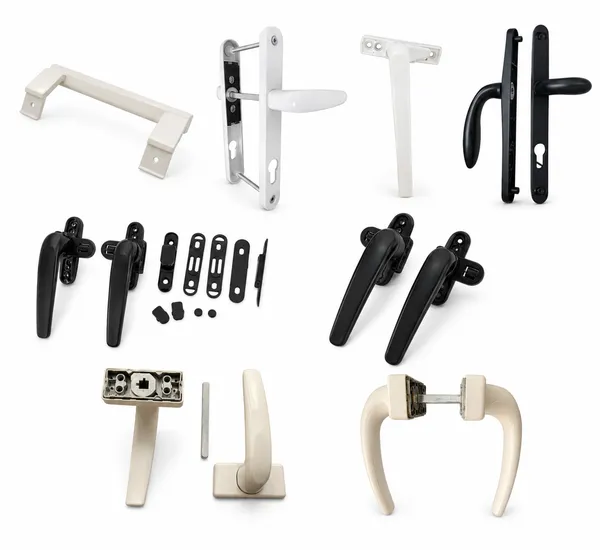
The related Door & Window Accessories category includes glass cutting tools, waterproof strips in PVC, rubber, or TPE, hinge screws and pins in steel or stainless steel, weather or pile strips, and screen-window roller tools. These items may be low in unit value, but a missing screw, seal, pin, guide, or installation tool can stop a complete opening from being handed over.
| Accessory group | Published material reference | Buyer checks |
|---|---|---|
| Waterproof strips | PVC, rubber, or TPE | Profile, glass or panel thickness, lip direction, length, environment |
| Hinge screws and pins | Steel or stainless steel | Thread, diameter, length, head, finish, hinge and reinforcement match |
| Weather and pile strips | Pile with backing or rubber | Backing width, pile height, compression, groove fit, cut length |
| Roller tools | Application-specific tool assemblies | Wheel profile, handle, replaceable parts, target screen or gasket |
No product-level certificate numbers are publicly disclosed for this category. If a project requires a specific material report, test report, declaration, or regulatory document, include that requirement in the quotation request and confirm availability before ordering.
Bulk packaging can reduce material and handling cost, but mixed loose cartons make site control difficult. Project packaging should protect finished surfaces and allow installers to identify the opening without unpacking every component.
Choose one of three structures: individual SKU cartons for distribution stock, complete opening kits for projects, or zone kits for phased installation. An opening kit may include the handle, lock components, cylinder, strike, fixings, templates, and label. Keep spare parts and maintenance stock in separately marked cartons so they are not consumed during installation.
Specify the label fields: purchase order, project, building, floor, room, opening number, hardware set, item code, quantity, finish, handing, carton sequence, and barcode if required. Define pallet height, moisture protection, edge protection, carton weight limits, and whether inspection samples must remain accessible.
Inspection plans should match the drawing and failure modes. Check identity, quantity, dimensions, interface fit, function, finish, marking, assembly, accessories, and packaging. For critical sets, fit a sample to the actual door, profile, lock, track, or glass preparation before releasing the batch.
HIPAD states that internal quality checks are used during production and that third-party providers such as SGS and Bureau Veritas may be involved when required. That statement does not mean every bulk door hardware item carries an SGS, BV, or ISO product certificate. ISO 9001:2015 covers quality-management systems; project-specific hardware testing and documentation must still be defined separately.
Repeatability depends on retained data. Keep the approved model code, drawing revision, bill of materials, finish sample, packaging artwork, inspection plan, accepted deviations, and shipment records. For private-label products, also control logo files, label versions, barcode ownership, and carton language.
Ask the supplier to notify you before changing material, subcomponent, tooling, finish process, factory, packaging, or inspection method. A seemingly minor change can affect fit, appearance, corrosion behavior, or replacement compatibility. HIPAD supports drawing-based OEM/ODM development, structural and finish adjustments, branding, packaging, and private molds; project feasibility and commercial terms still require review.
Provide the door schedule, hardware sets, quantities, drawings, door and frame details, interface dimensions, materials, finishes, packaging, delivery phases, target market, required documents, and inspection criteria.
No universal price range or MOQ is publicly disclosed. Pricing and minimum quantities depend on the product family, material, finish, tooling, packaging, quantity, and delivery requirements. A project-specific quotation is required.
HIPAD supplies door, window, bathroom, stainless steel, glass, sliding-system, and accessory categories. Consolidation feasibility depends on production schedules, inspection, packaging, and shipment planning.
Reference the exact model, drawing revision, finish, handing, interface dimensions, and original project or purchase order. Store spares separately from installation quantities.
HIPAD supports OEM/ODM branding and customized packaging. Submit controlled artwork, position, process, label data, barcode rules, and approval requirements.
A useful bulk door hardware inquiry is already structured for technical review: one door schedule revision, measurable interfaces, approved finish references, itemized quantities, packaging rules, delivery phases, and inspection criteria. This gives the supplier enough information to identify gaps before sampling and gives the buyer a controlled basis for comparing quotations.
HIPAD ile İletişime Geçin with your opening schedule, drawings, quantity breakdown, finish references, packaging requirements, and target delivery phases for a project review.
Allen Wang is CEO and Founder of HIPAD. He began his career in 1998 as a technical engineer in Qingdao, developing hands-on experience in manufacturing processes, tooling, mechanical components, and product quality. His work with international distributors, door and window manufacturers, contractors, and project buyers covers product selection, material and finish matching, drawing-based customization, OEM/ODM development, private molds, packaging, and system compatibility.
24 saat içinde yanıt vereceğiz. Acil talepleriniz için WhatsApp/WeChat üzerinden +86 137 9191 8989 numarasından bize ulaşabilir veya aynı numarayı doğrudan arayabilirsiniz.
*Gizliliğinize saygı duyuyor ve tüm bilgilerinizi koruyoruz.
Bilgilerinizi yalnızca talebinize yanıt vermek için kullanırız; izniniz olmadan e-posta veya tanıtım mesajı göndermeyiz.